Identifying a rock comes down to reading a handful of clues: its color, the size of its grains, how hard it is, how it breaks and how it reflects light. Work through them in order and most common rocks fall into place. Here is how to do it by hand, and how to shortcut the whole process with your phone.
Start with the three rock families
Every rock is igneous, sedimentary or metamorphic, and knowing which family you are holding narrows things down fast.
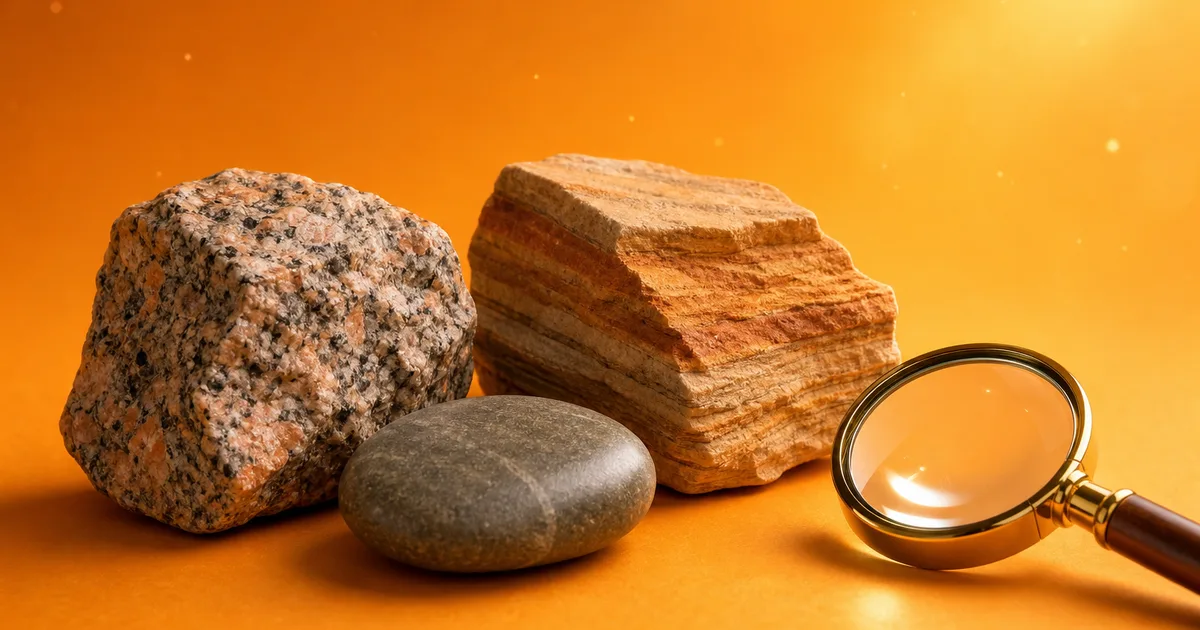
Igneous rocks cooled from molten rock and often look crystalline or glassy (granite, basalt). Sedimentary rocks formed from layers of sediment and often show grains, layers or fossils (sandstone, limestone). Metamorphic rocks were reshaped by heat and pressure and often show banding or a sheen (gneiss, schist, marble). See the full breakdown in our guide to the types of rocks.
Look at color and grain
Color is a first hint, not an answer, since the same mineral can come in many colors. More useful is grain size: can you see individual crystals or grains, or is the rock smooth and uniform? Coarse grains suggest slow cooling or coarse sediment; a fine, even texture suggests fast cooling or fine mud.
Test the hardness
Hardness is one of the most reliable tests. Can you scratch the rock with a fingernail, a copper coin, or a steel knife? Where it sits on the 1 to 10 Mohs scale rules whole groups of minerals in or out. Learn how to run the test in our Mohs hardness scale guide.
Check luster, streak and breakage
Luster is how the surface reflects light: metallic, glassy, pearly or dull. Streak is the color of the powder the rock leaves on an unglazed tile, often different from the surface color. And how it breaks matters too: clean flat faces (cleavage) versus curved or irregular fractures point to different minerals.
The fast way: identify a rock from a photo
Working through every test by hand is rewarding, but slow. Rock Identifier: GeoLens does it in seconds: take a photo and the app returns the most likely identification with a confidence score, then a full profile covering type, hardness, composition and value.
Identifying a crystal or a mineral specifically? We have focused guides for those too.
Frequently asked questions
What is the easiest way to identify a rock?
Can you identify a rock just by its color?
How can I tell what type of rock I have?
Stop guessing, identify it in seconds with GeoLens.