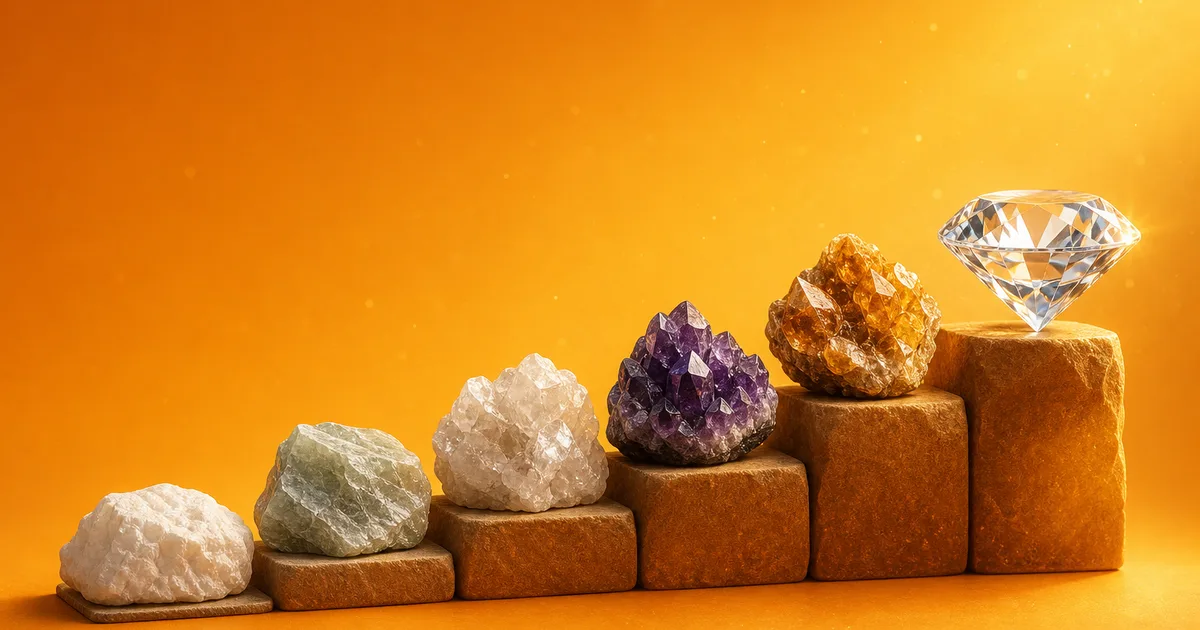
The Mohs hardness scale ranks minerals from 1 (softest) to 10 (hardest) by which can scratch which. It is one of the oldest and most useful tools in geology because you can run it anywhere with a few everyday objects. Here is the full scale and how to use it.
The scale from 1 to 10
Devised by Friedrich Mohs in 1812, the scale uses ten reference minerals. A mineral can scratch anything softer than itself and be scratched by anything harder.
- 1 - Talc (crumbles in your fingers)
- 2 - Gypsum
- 3 - Calcite
- 4 - Fluorite
- 5 - Apatite
- 6 - Orthoclase feldspar
- 7 - Quartz
- 8 - Topaz
- 9 - Corundum (sapphire, ruby)
- 10 - Diamond
It is relative, not linear
The steps are not evenly spaced. Diamond at 10 is many times harder than corundum at 9, even though they are one step apart. So Mohs tells you the order of hardness, not how much harder one mineral is than another.
How to test hardness at home
You do not need the reference minerals. Common objects have known hardness you can use as scratch tools:
- Fingernail - about 2.5
- Copper coin - about 3.5
- Steel knife or nail - about 5.5
- Glass - about 5.5
- Steel file - about 6.5
Try to scratch the mineral with each, starting soft. If your fingernail marks it, it is 2 or softer; if a knife will not scratch it but it scratches glass, it is about 6 to 7 (quartz territory). Always test on an inconspicuous spot.
Why hardness matters
Hardness is one of the most diagnostic mineral properties, it rules whole groups in or out at once. It also tells you how a gemstone will wear: stones at 7 and above resist everyday scratches, which is why quartz, sapphire and diamond are favoured in jewelry.
Let the app estimate it
Rock Identifier: GeoLens reports an estimated hardness as part of every identification, alongside luster, composition and value. See it with the mineral identifier, or read how to identify minerals for the other key tests.
Frequently asked questions
What is the Mohs hardness scale?
How do you test hardness without a kit?
Is the Mohs scale linear?
Stop guessing, identify it in seconds with GeoLens.