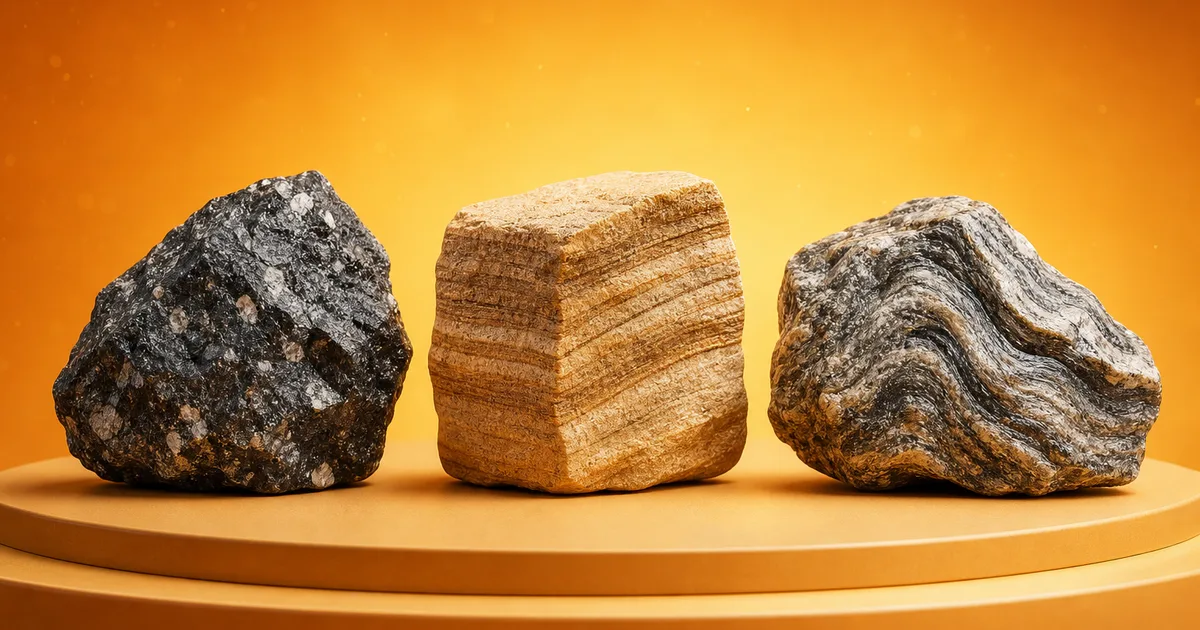
All rocks on Earth belong to one of three families, defined by how they formed: igneous, sedimentary and metamorphic. Together they cycle into one another over geological time. Here is what each one is, with examples and the clues that give them away.
Igneous rocks: cooled from molten rock
Igneous rocks form when molten rock (magma below ground or lava above it) cools and hardens. Cool it slowly underground and large crystals grow, giving coarse rocks like granite; cool it fast at the surface and you get fine-grained or glassy rocks like basalt and obsidian.
Clue to look for: an interlocking, crystalline texture, or a glassy, bubbly look.
Sedimentary rocks: built from layers
Sedimentary rocks form when sediment (sand, mud, shells, dissolved minerals) settles, gets buried and cements together. They include sandstone, shale and limestone, and because they build in layers, they are the rocks most likely to contain fossils.
Clue to look for: visible grains, flat layers (strata), or fossils.
Metamorphic rocks: changed by heat and pressure
Metamorphic rocks start as igneous or sedimentary rock and are then transformed by intense heat and pressure deep in the crust, without fully melting. Limestone becomes marble; shale becomes slate, then schist, then gneiss.
Clue to look for: banding or stripes, a foliated (sheety) texture, or a hard, recrystallised sheen.
The rock cycle
These three types are not fixed. Mountains erode into sediment that becomes sedimentary rock; burial and heat turn it metamorphic; deeper still it melts and cools again as igneous rock. This is the rock cycle, and it is why the same elements reappear in very different stones.
Tell them apart in seconds
Not sure which family your specimen belongs to? Rock Identifier: GeoLens identifies it from a photo and tells you the type along with its hardness, composition and formation. Start with our guide on how to identify rocks.
Frequently asked questions
What are the three types of rocks?
Which type of rock contains fossils?
How do you tell igneous, sedimentary and metamorphic apart?
Stop guessing, identify it in seconds with GeoLens.