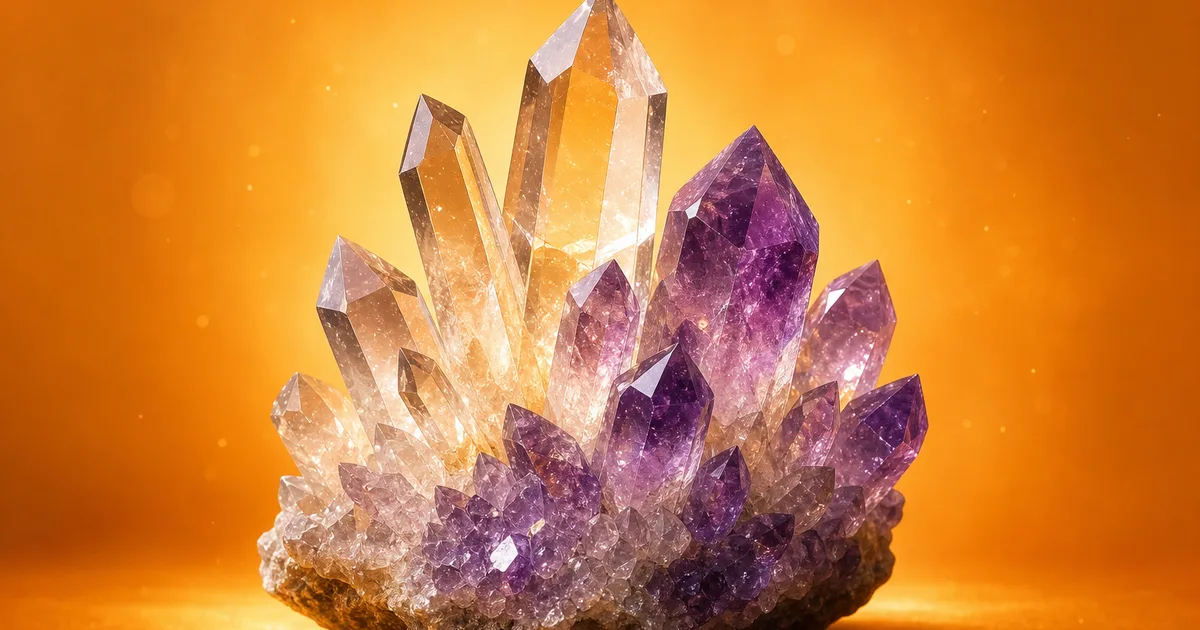
Crystals are minerals that grew into regular geometric shapes, and that shape is the biggest clue to what they are. Combine the crystal form with color, transparency and hardness and you can identify most common crystals. Here is how.
Read the crystal shape
Crystals grow in a fixed internal pattern called a crystal system, and it shows in the outside shape. Quartz forms six-sided prisms ending in points; pyrite forms cubes; garnet forms rounded many-faced balls. Learning to recognise a few of these shapes is the single most useful crystal-ID skill.
Note color and transparency
Color helps but can mislead, since impurities change it (purple amethyst and yellow citrine are both quartz). Transparency is steadier: is the crystal clear, cloudy or opaque? Weigh it alongside shape and hardness rather than on its own.
Test hardness and luster
Hardness narrows the field quickly. A crystal that scratches glass is hard (quartz and harder); one a knife scratches easily is soft. Luster ranges from glassy (quartz) to pearly (mica) to metallic (pyrite). Our Mohs scale guide shows how to test it.
Watch for healing-crystal lookalikes
Popular healing crystals are just mineral species under friendly names: rose quartz, amethyst, citrine and clear quartz are all quartz; much "opalite" is glass. Identifying the real mineral tells you the genuine properties behind any crystal.
Identify a crystal instantly from a photo
To skip the manual tests, Rock Identifier: GeoLens identifies a crystal from a single photo and shows its crystal system, hardness, color cause and value. Try the crystal identifier on a raw point, a cluster or a polished tumble.
Frequently asked questions
How do you identify a crystal?
Are all healing crystals real minerals?
Can the app identify polished crystals?
Stop guessing, identify it in seconds with GeoLens.